Basic Composition Of Motorcycles
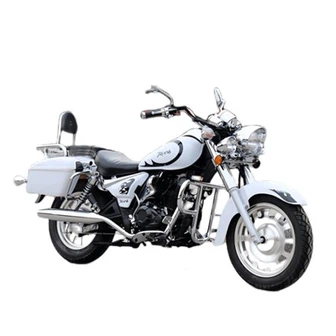
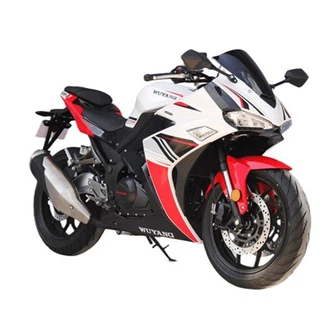
A motorcycle is composed of five parts: engine, transmission system, walking system, steering, braking system, and electrical instrument equipment. The overall structure of the motorcycle and the names of its components.
engine
1. Characteristics of Motorcycle Engines
(1) The engine is a two-stroke or four-stroke gasoline engine.
(2) Adopting air cooling, there are two types: natural air cooling and forced air cooling. The general model adopts a natural air cooling method that relies on air blowing through the cylinder head and heat dissipation fins on the cylinder sleeve during driving to remove heat. In order to ensure the cooling of the high-power motorcycle engine at low speeds and before starting, a forced air cooling method is adopted by installing a fan and air guide cover, and using forced air to cool the heat dissipation fins.
(3) The engine speed is high, usually above 5000 rpm. The power output per liter of engine displacement is large, usually around 60 kilowatts per liter. This indicates that the motorcycle engine has a high degree of reinforcement and a small overall size.
(4) The design of the engine crankcase, clutch, and gearbox is integrated, with a compact structure.
2. Body
The engine body is composed of cylinder head, cylinder block and crankcase. The cylinder head is made of aluminum alloy cast with heat sink. The new four stroke motorcycle engine adopts overhead valve, chain drive and overhead camshaft structure. The cylinder body material is mostly bimetallic (wear-resistant cast iron cylinder liner with aluminum heat dissipation fins) to achieve better heat dissipation effect. Some motorcycles use wear-resistant cast iron cylinder blocks, such as Changjiang 750 and Jialing JH70. Some small moped, such as Yuhe brand YH50Q small displacement (50 cubic centimeters) engines, use aluminum alloy cylinder blocks with 0.15 mm hard chromium coating on the inner wall. The crankcase is made of aluminum alloy die-casting and consists of a combination of left and right boxes. Some motorcycles have buffer blocks added between the heat dissipation characteristics to suppress the noise emitted by the vibration of the heat dissipation fins.
3. Crank connecting rod
The crankshaft of the motorcycle engine adopts a combination type, which is formed by pressing the left half crankshaft, right half crankshaft, and crankshaft pin. The main journals of the left and right half shafts are equipped with ball bearings to support the crankshaft on the crankcase. The two ends of the crankshaft are respectively equipped with flywheels, magnetos, and clutch driving gears. The connecting rod is of an integral structure, with a large end in a circular shape, and is equipped with a needle roller bearing and a crank pin assembly to form a crank connecting rod assembly. In the two-stroke engine, when installing the piston ring, pay attention to align the opening of the piston ring with the locating pin in the piston ring groove to prevent the piston ring from rotating in the ring groove, causing air leakage and scratching the air inlet and exhaust ports on the cylinder liner.
4. Carburetor
The carburetor is an important component in the motorcycle fuel supply system, located between the air filter and the engine intake. Generally, motorcycle engines use a flat suction intake airflow direction, a plunger throttle valve, and a float chamber carburetor. The carburetor structure mainly consists of two parts: a float chamber and a mixing chamber. The float chamber is located below the carburetor, and there is an oil pipe that passes through the throttle switch to the oil tank. Through the needle valve on the float, the oil level in the float chamber is maintained at a certain height to stabilize the oil supply pressure. The function of the mixing chamber is to evaporate and atomize gasoline and mix it with air, enabling the engine to obtain the required mixture at various loads and speeds. It is composed of an energy-saving valve, an injection needle, an injection pipe, and an air and oil passage.
The rotation of the motorcycle throttle handle drives the throttle wire rope to control the up and down movement of the throttle valve and fuel injection needle, changing the cross-sectional area and fuel supply of the intake pipe to meet the needs of mixed gas under different speeds and loads. An idle speed adjustment screw is installed on one side of the carburetor to adjust the idle speed. The idle stop screw is used to prevent the throttle valve from rotating and adjust the minimum opening of the throttle valve. There is a return spring above the throttle valve, which closes the throttle valve when the throttle handle is not rotating.
On some two-stroke motorcycle engines, a one-way reed valve is installed between the carburetor and the cylinder block to control the intake air in order to avoid reverse injection of the carburetor at low speeds. The spring is made of thin spring steel sheets, and the valve seat is made of aluminum alloy. There is an air inlet on the top, and a layer of oil rubber is pasted on the contact parts between the air inlet plane and the spring to reduce the impact and vibration between the spring and the valve seat. When inhaling, a certain vacuum is formed in the crankcase. Under the pressure difference, the reed valve opens and the mixture enters the crankcase. When the piston goes down and the air exchange port is not yet open, the pressure inside the crankcase increases and the reed valve closes, preventing the mixture from flowing back, improving the power and economy of the engine at low speeds.
5. Lubrication system
The four stroke engine adopts a lubrication method that combines splash lubrication and pressure lubrication. Two stroke engines generally use a mixed lubrication method of mixing a certain proportion of QB grade gasoline engine oil into gasoline. However, regardless of the engine operating conditions, the mixed oil of this lubrication method is supplied with lubricating oil in a predetermined proportion, increasing the consumption of lubricating oil, incomplete combustion, more carbon deposition, and exhaust pollution. The new generation of two-stroke engines adopt a separate lubrication method, equipped with a separate lubrication tank and oil pump. The oil pump generally adopts a reciprocating plunger type variable oil supply pump, which is driven by the crankshaft gear through a worm gear and worm. The fuel supply is linked to the carburetor throttle valve through the throttle handle, control cable, and throttle valve, so that the oil supply varies with the engine speed. At high speed, there is more fuel supply, while at low speed, there is less fuel supply, which is reasonable and can save more oil compared to the hybrid lubrication method. The engine oil is blown away by a high-speed mixture to form a small oil mist, which is supplied to the parts that need lubrication, reducing the amount of engine oil entering the combustion chamber. The mixture burns completely, reducing carbon deposition and exhaust pollution.
6. Starting
The starting method of motorcycles is mainly pedal starting. The starting mechanism includes a sector gear starting mechanism represented by the Happy XF250 motorcycle. The pedal start gear lever drives the sector gear, starting ratchet, clutch assembly sprocket, front chain, and crankshaft sprocket to drive the crankshaft to rotate and start the engine. After the engine starts, the one-way action of the starting ratchet and the return spring restore the starting mechanism to its original position. This starting mechanism starts by shifting the starting gear lever to the neutral position and pressing the pedal.
Another type is the starting pedal type starting mechanism used in some imported models. Unlike the former, when starting, the first step is to grip the clutch handle tightly to release the clutch. The gear lever can be placed in any gear position, without having to be in neutral. After starting, release the clutch and increase the throttle to start. When the starting pedal is pressed, the pawl on the starting pedal shaft engages with the internal ratchet of the starting pedal transmission gear, causing the transmission gear to rotate. The crankshaft is driven by the idle gear, driven gear, clutch gear, and starting pinion to rotate and start the engine. After starting, the foot moves away from the starting pedal, and the return spring causes the pedal to rotate in reverse, causing the pawl to disengage from the engagement with the inner pawl and return to its original position.
Motorcycles with larger displacement, such as the Yangtze 750D motorcycle, Yamaha two cylinder motorcycle, Suzuki GT750 three cylinder motorcycle, and Honda CL1000 four cylinder motorcycle, all use a starting motor to start.